
In the ever-evolving landscape of healthcare, one constant remains: the need for continuous improvement and accountability. The Joint Commission (TJC)—long regarded as the gold standard in accrediting healthcare organizations—introduced enhancements to its accreditation process in January 2025. These strategic pivots, according to the Joint Commission, were designed based on feedback from Joint Commission organizations to modernize tools, alleviate burden, and provide better communications tools.
This article serves as your roadmap to understanding and navigating these enhancements, helping you transform accreditation into a strategic advantage.
Why the Enhancements? The Driving Forces Behind the Change
The Joint Commission’s latest enhancements are rooted in three core goals:
- Patient-Centered Excellence: Improving outcomes by promoting high-reliability practices and reducing variation in care.
- Data-Driven Oversight: Using performance data more effectively to target risk areas and ensure compliance.
- Streamlined Processes: Making the accreditation experience more efficient and less burdensome while still maintaining rigor.
Healthcare providers now face new expectations but also new opportunities to stand out as leaders in quality and safety.
Key Enhancements at a Glance:
- Redesigned survey report that is user-friendly and applicable to add accredited, certified, and verified healthcare organizations.
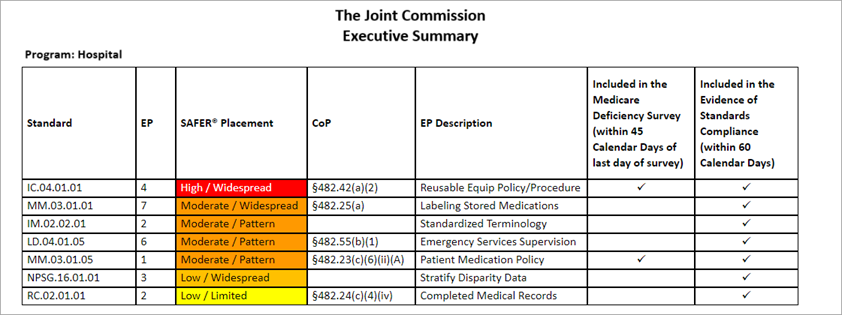
Source: The Joint Commission – January 8, 2025 Newsletter
The Survey Analysis for Evaluating Risk (SAFER®) Matrix has been updated to provide deeper insight into risk areas.
- Findings that are high-risk and/or widespread are listed first for prioritization.
- Identifies which findings require follow-up and associates them clearly with specific activities.
- Uses “short names” for standards and Elements of Performance (EPs) to enhance clarity and understanding of intent.
- For facilities using TJC for deemed status, the report better highlights deficiencies under Medicare regulations: Conditions of Participation (CoPs), Conditions for Coverage (CfCs), and Clinical Laboratory Improvement Amendments (CLIA ’88).
- Provides a concise overview of all findings and necessary follow-up in a single location for leadership review.
- Preliminary reports will now remain available beyond the last day of the survey. They will only be replaced when the final report is posted.
This empowers leadership teams to be proactive rather than reactive.
Improved SAFER® Matrix will use short descriptors or “short names” next to standard and Element of Performance (EP) numbers.
- Improve clarity by providing plain-English summaries that describe the intent of standards and EPs without requiring detailed familiarity with their codes.
- Enable healthcare staff to quickly grasp findings and focus on areas needing improvement.
This change streamlines communications across all levels of healthcare staff, regardless of familiarity with specific Joint Commission standards.
Access to a new SAFER® Peer Benchmarking Tool, designed to help organizations compare their survey results to peer institutions using data from the SAFER Matrix.
- Hospitals can compare their survey performance with other hospitals based on hospital type (e.g., academic medical center), bed size (e.g., 300+ beds), or setting (e.g., urban).
- Detailed benchmarking enables performance analysis in key areas such leadership, National Patient Safety Goals, and medication management.
- Access is limited to authorized users via the Joint Commission Connect® site.
- Benchmarking data is not traceable or identifiable to specific outside organizations.
- Information is strictly for internal use only.
- Hospitals may not use benchmarking data in marketing, external communications, or promotions. Statements like “top 95th percentile” are prohibited.
- The Joint Commission will not publish or publicly release benchmark rankings.
New, optional process allowing hospitals and critical access hospitals to upload survey-related documents directly through the Joint Commission Connect® extranet site during any type of survey.
- Provides faster and more efficient document sharing during survey events.
- Establishes a single, consistent location for storing all requested documentation.
- Enables seamless access to relevant documents for both surveyors and organizations.
- Reduces the use of printed documents, supporting a more sustainable approach.
- Applies to hospitals, critical access hospitals, and hospital tailored accreditation programs.
This new feature empowers healthcare organizations to digitally manage survey documentation, enhancing the efficiency, consistency, and environmental sustainability of the accreditation process.
Enhanced Transparency in For-Cause Surveys
Effective immediately, The Joint Commission has modified the for-cause survey process to improve organizational understanding and communication during these surveys. This applies to all accredited, certified, and verified healthcare organizations.
- When a complaint triggers a for-cause survey, surveyors will now pre-communicate the general reason for the survey and outline and review the survey plan for the day.
- While the broad focus of the survey will be shared, specific details of the allegation will not be disclosed unless confidentiality has been explicitly waived.
- At the close of the visit, surveyors will offer a verbal overview of their observations. They will also reference the applicable chapters from Joint Commission manuals (accreditation, certification, or verification), helping organizations link findings to specific standards.
- Organizations will have the opportunity to ask questions or seek clarification during this final discussion.
These modifications aim to increase clarity and reduce confusion during for-cause survey visits, promote a collaborative environment between surveyors and organizations, and ensure organizations have the opportunity to understand and respond to findings in real-time. This update reflects The Joint Commission’s commitment to transparency, fairness, and educational value during the survey process, especially in sensitive situations involving complaints or concerns.
Navigating the Transition: Tips for Success
- Educate and Empower Staff
Start with awareness. Host workshops and webinars to familiarize your teams with the new standards. Consider forming interdepartmental committees to translate the enhancements into actionable steps.
- Make Friends with Data
Use your existing Electronic Health Record (EHR) systems and analytics platforms to collect, stratify, and interpret patient care data. The SAFER® Matrix and dashboards aren’t just survey tools—they’re strategic assets.
- Integrate Equity into Daily Operations
Don’t treat equity as a checklist item. Embed it into hiring practices, community outreach, patient education, and clinical care protocols.
- Embrace Continuous Readiness
Shift from a “survey is coming” mindset to a “we are always ready” culture. This not only simplifies accreditation but also builds trust with patients and staff alike.
Strategic Benefits Beyond the Badge
Accreditation is more than a compliance milestone. Done right, it signals to patients, payers, and partners that your organization is committed to excellence. It:
- Enhances your public reputation.
- Strengthens payer negotiations.
- Attracts top-tier talent.
- Reduces liability through proactive risk management.
In an era where patient choice and accountability matter more than ever, leveraging Joint Commission accreditation as a strategic differentiator can elevate your organization’s standing in a crowded marketplace.
Final Thoughts
The Joint Commission’s enhancements are not just about meeting new rules—they’re about raising the bar for care delivery. Healthcare leaders who embrace these changes with curiosity, collaboration, and a quality-first mindset will find themselves not just surviving the accreditation process but thriving through it.
Are you ready to turn accreditation into your organization’s competitive edge?
Access this information on the Joint Commission at: https://www.jointcommission.org/resources/news-and-multimedia/newsletters/newsletters/joint-commission-online/jan-8-2025/