
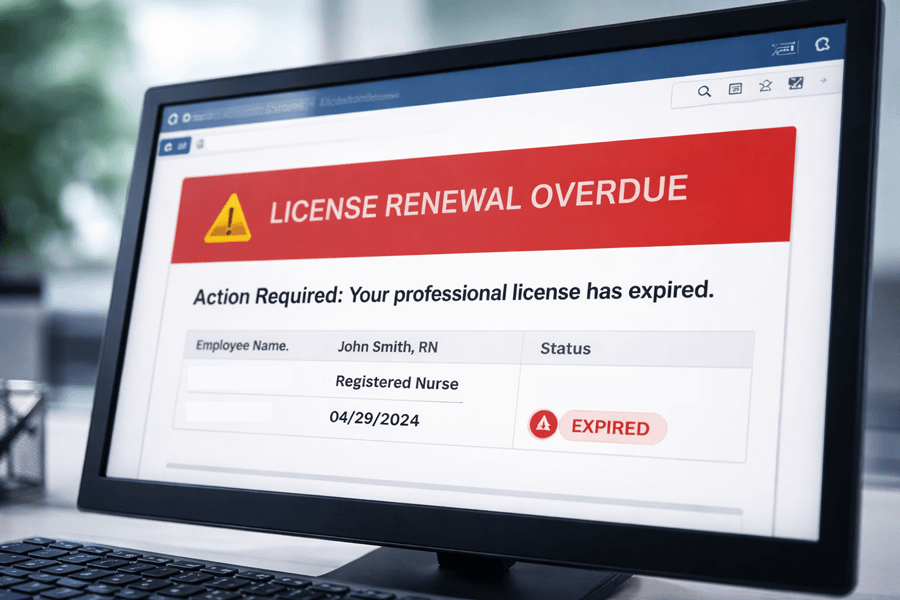
Short Answer: While individual clinicians are legally responsible for maintaining their licenses and certifications, healthcare employers share operational, legal, and financial responsibility for ensuring staff remain compliant. Failure to monitor continuing education (CE) and license renewal status can expose organizations to staffing disruptions, liability risk, accreditation findings, and reputational harm. A centralized compliance system reduces these risks and protects workforce stability.
CE Compliance That Pays Off: Protecting Your Workforce and ROI
In today’s hectic healthcare industry, healthcare leaders and administrators face relentless pressure from staffing shortages, high turnover, escalating liability costs, and the constant evolution of clinical practice. Whether driven by emerging technologies, updated clinical guidelines, new procedures, pharmaceutical advances, or legislative mandates, everyone must try to keep pace. Additionally, someone in the organization must ensure that all staff training records are kept up to date and that professional licenses and certifications remain current and valid. However, amid these competing priorities, continuing education (CE) compliance often gets relegated to the bottom of the to-do list—dismissed as “not that important.”
Many employers rationalize that “There is just not enough time in a day” or that “CE tracking is the individual’s professional responsibility, not ours.” But what happens when an employer doesn’t pay attention to this? CE gaps don’t remain hidden. They creep up when a license renewal is missed, when a surveyor asks for proof of training during an inspection, or more critically, after an adverse event, when documentation becomes the dividing line between “we were prepared” and “we were exposed.”
The reality is that CE compliance is not an administrative nicety. It’s a strategic imperative. Here’s why it matters for healthcare employers.
Protect your most expensive resource
Year after year, healthcare organizations’ highest expenses and investments center on three areas: staff salaries, liability insurance, and staff training. Employee retention is the most expensive and vulnerable asset, and CE compliance protects your workforce capacity. Most states mandate continuing education for professional license renewal across multiple disciplines, including nurses, nursing assistants, therapists, social workers, and other healthcare professionals. The number of hours and specific topic requirements vary by profession and state. For example, some state mandated topics include controlled substances, human trafficking, and/or implicit bias. In addition to their licensure, individuals with other professional certifications may also need to complete CE for renewal, which can also include required topics such as ethics and abuse and neglect reporting.
When staff manage their CE without organizational support, employers become vulnerable to staff being distracted by last-minute scrambling to complete CE courses, time spent on CEs that are not accredited, missing completion records, unplanned scheduling gaps, and most critically, expired licenses and certifications. Each delayed renewal triggers cascading consequences, including understaffing, reduced productivity, overtime spikes, the need for crisis coverage, and endless liabilities. Beyond the financial burden, these disruptions compromise patient safety and staff well-being.
A robust CE compliance system eliminates these hidden costs by ensuring workforce readiness. It transforms CE from an individual burden into an organizational strength, stabilizing operations and preventing avoidable crises.
Build defensibility and survey readiness
 Expecting and preparing for mishaps are essential for employers. When an incident occurs, and investigations begin, employers must demonstrate and be able to prove not only that a policy existed but also that staff were trained, competent, and current in their skills to perform the task. When a preventable error occurs, one of the first questions often asked is “Was the staff member trained and competent for the task?” A centralized CE and training record becomes part of the organization’s protective infrastructure—concrete evidence that education and training weren’t assumed; they are documented, verified, and maintained. CE compliance strengthens an organization’s ability to show that staff were trained appropriately and consistently—an important factor in internal investigations, incident reviews, and legal defense.
Defensibility and quality depend on continuous learning, not just initial orientation and training. Healthcare changes rapidly and continuously. Medication safety protocols are changed, infection prevention guidelines are updated, new technologies are introduced, and workflows are redesigned. CE helps ensure that all healthcare providers remain current in areas that directly influence patient outcomes.
Beyond state professional licensure rules, healthcare organizations often face expectations from accrediting bodies and quality programs that emphasize ongoing training and performance improvement. For example, The Joint Commission explicitly addresses continuing education expectations for privileged practitioners as part of hospital-sponsored education linked to performance improvement activities (Joint Commission, 2026).
Even outside hospital settings, the same principle applies; regulators and surveyors want to see that organizations don’t rely solely on orientation. They expect ongoing education, competency reinforcement, and documentation that training has been completed and is tracked.
Improve retention and reduce burnout
Turnover in healthcare is rarely about compensation alone. Employees leave when they feel unsupported, underprepared, overworked, and left behind. When staff lack confidence in their competencies or feel unsafe performing their duties, performance deteriorates, engagement drops, and dissatisfaction grows. This pattern is pervasive in healthcare.
Recent studies continue to highlight CE as important for competence and safer practice—particularly when it is structured and tied to real clinical needs rather than disconnected “content consumption.” A 2024 systematic review found continuing education can improve nursing knowledge and quality of practice (Health Professional Education, 2025).
The delivery method matters less than accessibility and relevance. While some advocate for in-person training, online education offers equivalent value with greater flexibility, which is critical in today’s demanding professional landscape. Effective CE programs don’t just “add training,” they reduce operational drag by making education faster to deploy, easier to complete, and easier to document. A 2022 systematic scoping review found online continuing education improves learning outcomes and helps overcome time and access constraints—two of the biggest pain points for busy healthcare professionals (Degruyter, 2022).
When CE programs align with role demands and clinical realities, they build confidence. And confidence directly combats burnout. This is where return on investment materializes: higher completion rates, fewer compliance emergencies, reduced stress, improved staff satisfaction, and better patient outcomes.
Final takeaway
CE compliance is a shared responsibility between employers and individuals. When a program is well-designed and executed, it becomes a measurable ROI strategy that leads to fewer operational disruptions, lower risk exposure, stronger retention, and more consistent clinical performance.
Employers who treat continuing education compliance and tracking as a core operational discipline gain tangible advantages, including safer care, increased staff retention, reduced liability risk, and improved survey readiness. Strategic partnerships with accredited CE providers, including the selection of pre-approved courses that align with and support licensure requirements, organizational priorities, and centralized documentation systems, are strong and smart leadership tools.
In an industry where margins are thin and stakes are high, CE compliance isn’t optional but rather foundational to organizational resilience and excellence.
Organizations that treat CE compliance as a strategic infrastructure function, not an afterthought, position themselves for operational stability and defensibility. If you are evaluating centralized CE tracking and accredited education solutions for your workforce, it may be time to assess whether your current system truly protects your organization.

References:
Degruyter (2022). The Effects of Online Continuing Education for Healthcare Professionals: A systematic scoping review. (De Gruyter Brill)
The Joint Commission-Continuing Education, 2026. Continuing Education | Joint Commission
Tsapnidou, E. et al. (2024). The impact of Continuing Nursing Education on nurses’ knowledge and quality of practice: A systematic review. (Health Professions Education journal / Research Commons version). (HealthPRO Research Commons)

