
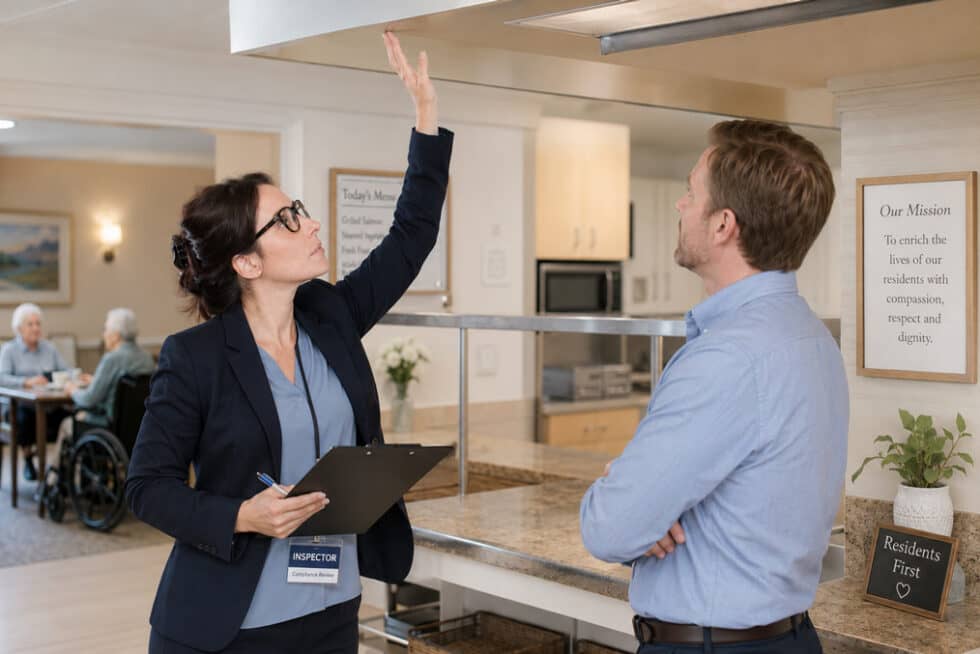
The California Department of Social Services (CDSS), Community Care Licensing Division (CCLD) released its 2025 Most Commonly Cited Deficiencies for Residential Care Facilities for the Elderly (RCFE) report in May 2026. For RCFE administrators, this report offers more than a list of citations. It is a useful reminder of the daily systems, staff practices, documentation habits, and safety procedures that help support facility compliance and quality resident care.
According to the report, the most cited deficiencies for inspections using the CARE Tool included areas such as Incidental Medical and Dental Care Services, Maintenance and Operation, Storage Space and Access, Personnel Records, Staff Training, Reappraisals, Personnel Requirements, Medical Assessment, and General Food Service Requirements.
For RCFE leaders, the report is a timely opportunity to review training priorities, internal procedures, and staff readiness.
Commonly Cited Deficiencies Highlight Daily Operational Risk
The 2025 report lists CCR 87465, Incidental Medical and Dental Care Services, as the most cited requirement section. Subsections include following requirements for centrally stored medications, developing a plan for incidental medical and dental care, and providing proper assistance with certain nonprescription PRN medications. These citations reinforce the importance of ensuring that staff who assist residents with the self-administration of medication receive the required initial and annual medication training to support understanding of proper procedures and documentation.
CareerSmart® Learning offers three RCFE medication training options:
- 10-Hour Initial Medication Training for facilities licensed for 15 or fewer residents
- 24-Hour Initial Medication Training for facilities licensed for 16 or more residents
- 8-Hour Annual Medication Training for facilities of any capacity
Each curriculum addresses essential medication management requirements and provides a consolidated Medication Training Certificate of Completion that facilities can retain in the employee’s record. The initial-training certificates also include space to document the required hands-on shadowing hours, helping facilities maintain training records for Licensing or LPA review.
Staff Training is Key
The report also includes H&S 1569.625(b)(1) as a common citation, which addresses required staff training for RCFE staff who assist residents with personal activities of daily living. The cited language includes initial training requirements that must be completed before staff work independently with residents, along with additional required training within the first four weeks of employment and annually thereafter. The report also references CCR 87411(c)(1), reinforcing the importance of required first-aid training for staff who provide care and supervision.
CareerSmart® Learning offers a 40-Hour Initial Caregiver Training curriculum for newly hired RCFE caregivers and a 20-Hour Annual Caregiver Training curriculum for ongoing education to meet initial and annual caregiver training requirements. Certified RCFE administrators can also complete the online, self-paced portion of their renewal education through the 20-Hour Online RCFE CE Curriculum, which includes required topic hours in dementia care, laws and regulations, and LGBTQ sensitivity.
Training requirements are a reminder that compliance depends on more than written policies. Staff must understand expectations, recognize risks, and know how to follow facility procedures in real care situations. Effective initial and ongoing training helps caregivers build the knowledge and confidence needed to support safe, consistent, and person-centered care.
Infection Control Is Connected to More Than One Citation Area
Infection control is often thought of as a standalone topic, but in day-to-day RCFE operations, it touches multiple areas of facility management. The May 2026 CDSS report highlights several commonly cited areas that can reasonably connect to infection prevention, sanitation, staff readiness, and resident safety.
Maintenance and Operation is one of the clearest examples. A facility that is clean, safe, sanitary, and in good repair is better positioned to support infection prevention practices and protect residents, staff, and visitors.
Storage Space and Access is another relevant area. The report cites CCR 87309(a), which requires disinfectants, cleaning solutions, poisonous substances, sharp objects, and similar items that could pose a danger to residents to be kept in locked storage and not left unattended when outside the locked storage. This is an important operational detail because infection control products must be available for proper cleaning and disinfection, but they must also be stored safely.
Personnel Requirements also connect to infection prevention. The report cites staff health-related requirements, including health screening and the expectation that personnel with evidence of illness or instability that poses a significant threat to resident well-being be relieved of their duties. In residential care settings, staff health, resident vulnerability, and infection prevention are closely linked.
General Food Service Requirements are also included among the most cited sections. Food service practices can affect sanitation, infection risk, and resident safety, especially in communities serving older adults and residents with health vulnerabilities.
Together, these areas show that infection control extends beyond one policy, one staff member, or one annual training. It is woven throughout the systems, practices, and processes that promote safe facility operations.
Why Infection Control Training Matters for RCFEs

Older adults and residents in assisted living or residential care settings may be more vulnerable to infection-related complications. Infection prevention practices help protect residents, staff, and visitors by reducing avoidable risks in everyday care.
Proper infection control training can help staff understand:
- How infections spread in residential and long-term care settings.
- Why cleaning, disinfection, hand hygiene, and safe storage practices matter.
- How to recognize common infection risks.
- How to respond to bloodborne pathogen exposure concerns.
- How respiratory, skin, and drug-resistant infections can affect residents.
- How staff practices support a safer facility environment.
When staff receive appropriate infection control training, they are equipped to better understand the “why” behind infection control procedures and are better prepared to follow them confidently and consistently.
Supporting the Infection Control Lead
California RCFEs are required to designate an Infection Control Lead for each facility, as outlined in CDSS Title 22 regulations. This role is responsible for creating and implementing the facility’s infection control plan and guiding staff in maintaining safe, effective infection prevention practices that support resident, staff, and visitor safety. That responsibility requires practical knowledge of infection prevention principles, disease transmission, common infection risks, and facility-level prevention strategies.
CareerSmart® Learning’s Infection Control Certificate Program is a self-paced online certificate program that meets California Department of Social Services Title 22 requirements for infection control training for the designated Infection Control Lead in RCFEs.
The program is appropriate for:
- CA Assisted Living, RCFE Administrators
- CA Adult Residential Facility, ARF Administrators
- Infection Control Leads
- Caregivers
- Nurses
- Medication technicians
- Assisted living staff
- Supervisors and staff responsible for supporting infection prevention practices
The program is also approved by the California Board of Registered Nursing for 6 CE/Contact Hours for Nurses.
Building a Stronger Culture of Readiness
The May 2026 CDSS report is a reminder that commonly cited deficiencies often reflect day-to-day systems: how staff are trained, how procedures are followed, how records are maintained, and how facility conditions are managed.
While staff training is only one component of maintaining regulatory compliance, it is a critical part of building a culture of readiness and confidence in providing safe, quality care. When staff receive effective initial training and ongoing education, they are better equipped with the knowledge and skills needed to fulfill their responsibilities, adapt to changing care needs, and support a safe, high-quality care environment.
For RCFE leaders, now is a good time to review training programs to confirm staff competency requirements are being met identify areas for improvement, and strengthen the practices that support resident safety, staff development, and quality care.
Learn more about CareerSmart® Learning’s Assisted Living training solutions.

