
In healthcare, knowledge has a shelf life. New evidence emerges. Clinical guidelines change. Technology evolves. Medications and treatments advance. Patient populations become more complex. Yet, healthcare professionals are expected to make safe decisions every day, often in fast-moving situations where recognizing a subtle change or communicating the right information at the right time can make a significant difference.
That is where continuing education (CE) becomes more than a professional requirement. When education is relevant, evidence-based, and connected to practice, it can become an important component of patient safety.
The American Nurses Credentialing Center (ANCC) emphasizes that nursing continuing professional development supports lifelong learning and continued competence in a rapidly changing healthcare environment. Importantly, the ANCC educational design process considers outcomes that can affect professional nursing practice as well as patient or system outcomes (American Nurses Credentialing Center [ANCC], 2025).
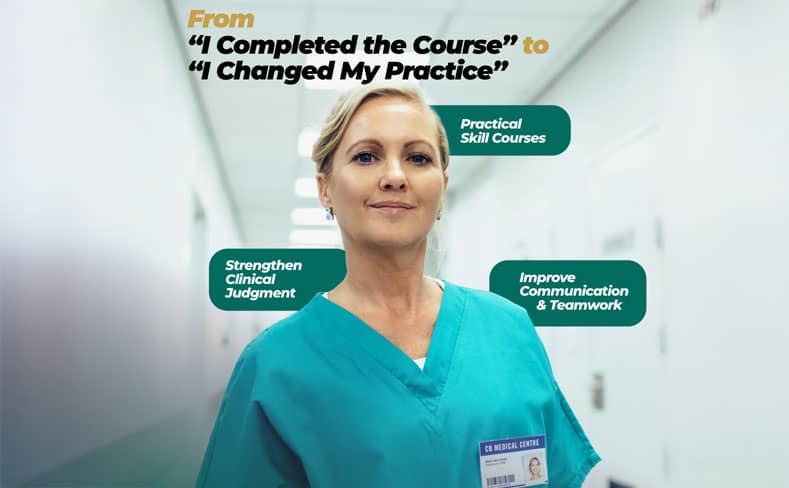
From “I Completed the Course” to “I Changed My Practice”
It can be tempting to think of continuing education primarily in terms of contact hours, certificates, or professional license renewal. But the real value of professional development is what happens after the course ends.
Did the learner recognize a risk they might previously have missed?
Did they change the way they communicate during a patient handoff?
Did they identify an outdated practice and replace it with current evidence?
Did they feel more prepared to escalate a change in a patient’s condition?
Did the education help prevent an error?
These are the questions that connect continuing education to patient outcomes.
ANCC’s outcome-based continuing education model illustrates this progression. Learning can move beyond acquiring knowledge and skills toward integrating learning into practice and ultimately demonstrating behaviors that affect practice, patient, and/or system outcomes (ANCC, 2025).
Keeping Practice Current
Healthcare knowledge does not stand still. Recommendations related to medications, infection prevention, chronic disease management, patient assessment, technology, documentation, and countless other areas continue to evolve.
Without ongoing professional development, healthcare professionals may unknowingly rely on practices that no longer reflect current evidence.
Continuing education helps close that gap by providing opportunities to review emerging evidence, update existing knowledge, and incorporate current recommendations into practice. ANCC identifies evidence-based educational activities and continued professional competence as central elements of accredited nursing continuing professional development (ANCC, 2025).
For the patient, that matters.
A healthcare professional who remains current is better positioned to recognize risk, select appropriate interventions, educate patients accurately, and identify when a situation requires additional evaluation or escalation.
Strengthening Clinical Judgment
Patient safety depends on more than knowing facts. Healthcare professionals must recognize what is happening, determine which information is important, decide what action is needed, and evaluate the patient’s response.
Consider a patient whose vital signs technically remain within expected parameters but who suddenly appears confused, restless, or increasingly short of breath.
A clinician focused only on the numbers might wait.
A clinician who has recently completed education on patient deterioration may recognize those subtle changes as warning signs and escalate the concern.
The difference is not simply knowledge. It is the ability to translate knowledge into clinical judgment and action.
Well-designed continuing education can strengthen this connection by incorporating realistic patient scenarios, case studies, simulation, decision-making exercises, and opportunities to apply evidence to practice.
Improving Communication and Teamwork
Some patient safety problems do not occur because healthcare professionals lack clinical knowledge. They occur because critical information is incomplete, delayed, misunderstood, or never communicated.
The Agency for Healthcare Research and Quality (AHRQ) identifies communication as one of the essential skills needed for safe, efficient, and patient-centered care. Its evidence-based TeamSTEPPS program was specifically designed to improve patient outcomes by strengthening communication and teamwork among healthcare teams (Agency for Healthcare Research and Quality [AHRQ], n.d.).
Research supporting TeamSTEPPS also demonstrates an important principle for continuing education: training can change healthcare professionals’ knowledge, attitudes, and behaviors related to teamwork and communication, but education is most effective when it is accompanied by implementation and sustained organizational commitment (AHRQ, n.d.).
Structured communication strategies such as SBAR (Situation, Background, Assessment, Recommendation), check-backs, handoffs, and other standardized approaches can help reduce ambiguity and ensure important information reaches the right person.
Continuing education can also bring disciplines together. Nurses, physicians, case managers, social workers, rehabilitation professionals, nursing assistants, and other members of the healthcare team may approach the same patient from different perspectives. Interprofessional education helps professionals understand one another’s roles and creates opportunities to practice communication and collaboration before a high-risk situation occurs.
Safer care is rarely the work of one person. It is the result of a team that knows how to recognize, communicate, and respond to risk.
Preventing Errors Before They Reach the Patient
Patient safety education can also help healthcare professionals understand why errors occur. Medication errors, diagnostic delays, communication failures, documentation problems, infection risks, falls, and other adverse events are rarely explained by a single factor. Human factors, workflow design, technology, staffing, policies, communication, and organizational culture can all contribute.
Education that incorporates systems thinking, quality improvement, teamwork, communication, human factors, and error-prevention strategies can help healthcare professionals look beyond individual mistakes and examine the conditions that contribute to unsafe care.
The World Health Organization’s Global Patient Safety Action Plan 2021–2030 emphasizes the need to eliminate avoidable harm and improve patient safety across healthcare systems and at the point of care (World Health Organization [WHO], 2021).
This supports an important shift in thinking from:
“Who made the mistake?”
to:
“What contributed to this event, and what can we change to reduce the likelihood that it happens again?”
That shift is essential to building a culture of safety.
Building Confidence to Speak Up
Education can also influence whether healthcare professionals are prepared to act when something does not seem right.
Imagine a nursing assistant who notices that a normally talkative resident has become unusually quiet and confused. Or a nurse who recognizes that a patient’s condition is worsening despite relatively small changes in vital signs. Or a case manager who identifies a medication discrepancy during a transition of care.
Knowing what to observe, when to be concerned, who to notify, and how to communicate the concern can turn observation into action.
AHRQ’s TeamSTEPPS framework reinforces this principle by teaching healthcare team members structured methods for sharing information, clarifying concerns, monitoring situations, and supporting one another. Effective teamwork and communication are foundational to providing safe, high-quality care (AHRQ, n.d.).
Continuing education can give healthcare professionals the knowledge and tools to speak up, escalate concerns, and advocate for patients.
Education Should Lead Somewhere
Completing a course is not the ultimate outcome of continuing education. Improved practice is. That is why meaningful professional development should begin with an identified educational or practice gap and end by asking whether learning made a difference.
Depending on the educational activity, outcomes might include:
- Increased knowledge or confidence
- Improved competency or skill performance
- Greater adherence to evidence-based practices
- Improved communication or documentation
- Reduced errors or adverse events
- Improved quality indicators
- Changes in professional practice
- Improved patient or organizational outcomes
ANCC’s outcome-based continuing education model reinforces this progression by recognizing that professional development can ultimately result in observable behaviors with an impact on professional practice, patients, and healthcare systems (ANCC, 2025).
Not every educational activity will directly reduce a measurable patient safety event. Healthcare outcomes are influenced by many factors. However, education can strengthen the knowledge, skills, judgment, communication, and behaviors that contribute to safer systems of care.
The Ripple Effect of Continuing Education
One healthcare professional completes an educational activity and changes a practice. That professional shares what they learned with a colleague. The team adopts a safer approach. A patient receives better care.
That is the potential ripple effect of continuing education.
When continuing education is designed around real practice gaps and current evidence, its impact can extend far beyond earning a certificate of completion. It can influence how healthcare professionals think, communicate, collaborate, recognize risk, and respond when patient safety is at stake.
The next time you complete a continuing education course, consider asking yourself one additional question:
What will I do differently because of what I learned?
Because ultimately, the most meaningful measure of continuing education is not the number of hours completed. It is what happens differently for the patient because learning occurred.
Put Continuing Education Into Practice
Continuing education has the greatest value when what you learn changes what you notice, how you communicate, or what you do next.
If patient safety is an area you would like to continue building on, consider these CareerSmart® courses:
Think Clearly, Speak Clearly: Support Safe Practice with SBAR and Closed-Loop Communication
Practice structured communication strategies that can help make handoffs, escalation, and team communication clearer and more consistent.
Medication Errors and Safety
Examine the human and system factors behind medication errors and practical strategies healthcare professionals can use to reduce risk.
Medical Errors Series
Review continuing education focused on preventing medical errors, understanding contributing factors, and applying practical strategies that support safer care across a variety of healthcare settings.
Sepsis: A Deadly Encounter
Review the risk factors and clinical manifestations of sepsis and reinforce the importance of recognizing changes that may require timely intervention.
Fall Prevention in Older Adults
Identify common fall risks and consider practical interventions that can help reduce preventable harm among older adults.
Need More Nursing Contact Hours?
The CareerSmart® 30+ Nursing Contact Hour Bundle provides nurses with 33 accredited contact hours in one convenient package, including topics related to clinical judgment, sepsis, medical errors, ethics, health literacy, and other areas that can influence safe patient care.
As you complete each course, consider carrying one question back into practice:
What will I do differently because of what I learned?

References
Agency for Healthcare Research and Quality. (n.d.). Section 2: Explanation and value of the TeamSTEPPS curriculum. U.S. Department of Health and Human Services. https://www.ahrq.gov/teamstepps-program/curriculum/intro/explain.html
Agency for Healthcare Research and Quality. (n.d.). Section 2: Explanation of key concepts and tools. U.S. Department of Health and Human Services. https://www.ahrq.gov/teamstepps-program/curriculum/communication/tools/index.html
Agency for Healthcare Research and Quality. (n.d.). TeamSTEPPS 3.0. U.S. Department of Health and Human Services. https://www.ahrq.gov/teamstepps/instructor/essentials/coursemgmtappa.html
American Nurses Credentialing Center. (2025). Nursing continuing professional development accredited provider policy and operations manual (Version 1.0, 2nd ed.). American Nurses Association.
American Nurses Credentialing Center. (n.d.). Nursing continuing professional development. American Nurses Association. https://www.nursingworld.org/organizational-programs/accreditation/ncpd/
World Health Organization. (2021). Global patient safety action plan 2021–2030: Towards eliminating avoidable harm in health care. https://www.who.int/publications/i/item/9789240032705

